Storm
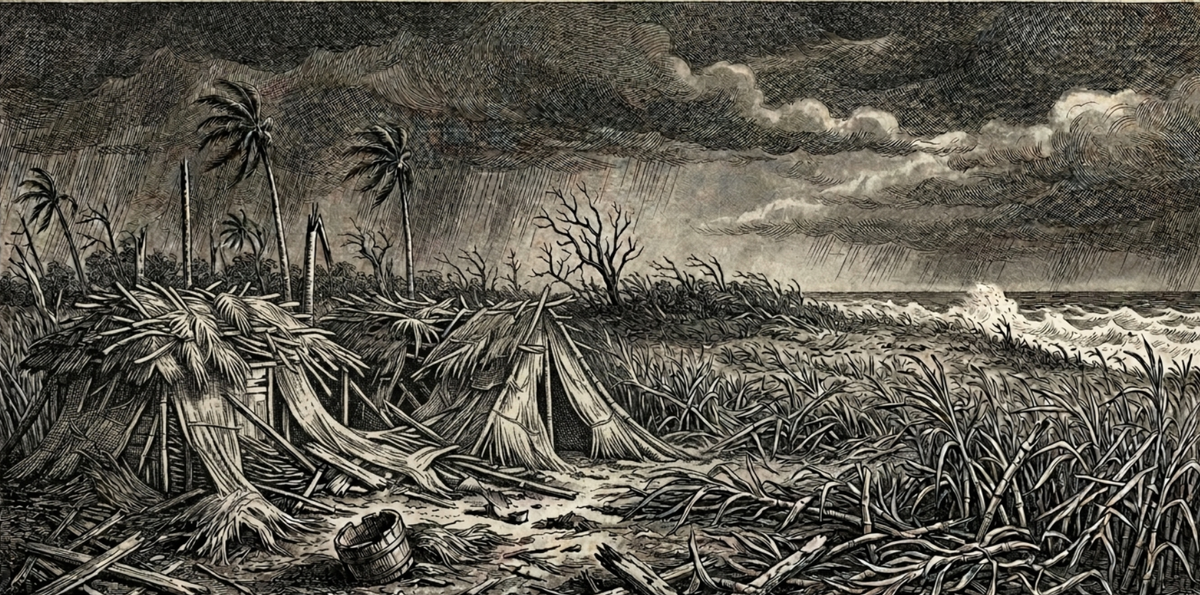
The sea foamed over the beach, spilling into the lemon grove. In a violent roar, their thatched roof rustled, shattered, exploded into shards, then vanished into the sky. Omotola grabbed Ife’s hand, Auntie seized the other and the chain of women fled through the canerows.
Ife's braids thrashed. Mud splattered her calves. At the forest's edge, treetops whipped the dirt. The women sprinted across the sugar field turned swamp, dodging flying gravel and timber chunks until Omotola pulled them into the bush.
Under the snapping branches, they covered each other's heads. The howling screech popped Ife's ears; the downpour blinded her. She staggered, hunched low, toward the base of the mountain until Omotola and Auntie shimmied into a furrow beneath a rocky overhang. Ife slithered on her belly behind them. Mud smeared her chest and soaked her hair. Wind whistled through their narrow hollow where just outside, the huracán battered the ridge, shrieking—-a cyclone of rage, spraying rain and chunks of earth into the shallow cave.
Omotola closed her eyes and drew a long breath. Auntie did the same. Ife covered her face and eventually, as flying bark pelted her, she closed her eyes too. She inhaled the wet air. Then let it out.
The wind calmed. The rain trickled to silence. When Ife opened her eyes, the sky had bruised itself purple and the setting sun cast a golden sheen over the tattered forest.
She wiped the grit and spat mud from her lip. Spittle clung to her chin. As she crept out of the cave, cool air filled her belly. The storm had vanished in a blink, leaving the earth doused and cratered. Trees lay splintered to shards. Rows of shredded cane rested under calm, violet starlight.
“Ife mi, the storm will be back,” Omotola said from the shadows of the rock. “Do not go far, Ife mi. You will see.”
The sky grumbled, then darkened. Drizzle fell. Ife stepped back. The gales swirled. She turned to run as thunder cracked overhead. Rain hammered the earth once more.
Ife scraped her scalp on the rock when she crawled back in. The storm pierced through her body with that high-pitched shriek. She fingered the welt puffing from her head—blood, mud, or rain, she could not tell. Then the remaining trees twisted, their final limbs cracking until the deluge blurred them from sight.
“Mama, what is it?” she shouted.
Omotola pressed her mouth close to Ife's ear and whispered, “Do not be afraid.”
The words settled cold in her chest. The storm raged outside, but soon enough the mountain ran dry of wind and water until stars flickered white and clear above.
Ife slid up from their rocky sanctuary, lending a hand to Omotola and Auntie, crawling into the night.
“Oh child, thank heavens that is over,” Auntie said, wringing the hem of her skirt.
“Come, Ife mi, help your Auntie.”
Ife balanced the old woman, stepping out of her mud-soaked wrapper. They stripped their heavy clothes, wrung the water out, and tied them back on. Omotola sat on a fallen trunk, pulling Ife between her knees to fix her braids under the fractured canopy.
“Mama, why did you make the storm?”
“What is it, Ife mi?” Omotola asked, detangling the wet knots with a twig.
“The storm. You stopped it. Then you said it would start again, and it did.”
Omotola paused, the twig hovering. “Is that what you think, Ife mi? That your mama make the wind?”
“Why did it start when you said it?”
“Oh, child...” Omotola sighed, her fingers back in Ife's hair. “I have seen the storm before. The wind always comes twice. First it is angry. Then the beauty. Then the angry monster returns from the other side.”
“It is fine to think your mama has such power,” Auntie said, sitting cross-legged against an uprooted stump. She leaned her head back. “There are women with such power, Ife mi. Where I come from in Asante, there was Abla Pokou. When war came, she led the people away. She spoke to the river, gave what she did, and carried everyone to a land of peace. Women are strong creatures. That is why the spirits give us the power to bring life.”
Ife pulled her knees to her chest. Her mother’s hands tightened a braid. “Is that where you come from, mama?”
“No, Ife mi. I come from Dahomey. But we have strong women there too—the Mino. They hunt beasts and they fight the wars. The men fear them because they protect the land. Auntie speaks the truth. We women are powerful creatures.”
“Then why we here?” Ife looked from her mother to the splintered cane fields. “Why not we go there?”
Omotola’s hands went still. “Oh, Ife mi. It is not for us to choose in this life.”
“Why not we choose? Why not we take a boat to where women have the power?”
Auntie flicked the mud between her toes and said nothing.
“Because we are here now,” Omotola said, her voice dropping low. “The sea swallows the boats. And if the water do not take us, Ife mi, then the English will make us pray for death.”
Ife dug her face into her knees, the damp fabric cold against her cheeks.
Auntie reached out, placing a rough hand on Ife's ankle. “We have our own powers, Ife mi. You will see. Just like the storm. We know when to hide, and we know when to fight. Look around. We are here tonight.”
By morning the ocean receded. The canerows lay tangled and slick with silt. Ife knelt in the tree line, supping water from a muddy puddle. Above her, a grackle screamed from a broken branch. When they walked back to the Narrows, the huts vanished, their gardens mashed to pulp. Severed tree limbs and limp bodies lay half-buried in the mud. Survivors sifted through the wreckage. Eban and Whistler’s son, Philip, were already loading the mule cart, prying the silent little ones from weeping mothers. They ordered the rest to gather whatever cane could be salvaged.
Ife piled the splintered cane stalk, her bare feet shuffling through the warm, hardening sludge of the crop trenches. She felt only the hollow ache in her belly and the lingering cries of the mothers. Nearby, Omotola hummed.
Richard Whistler surveyed the leveled land. Without his wig, his bald head shimmered brighter than his blouse, clean and untouched by the muck. He stood with his hands on hips across the way, gesturing at the ravaged fields while Philip nodded. Eban moseyed over to Ife.
“Go to the English house.”
Ife glanced at Omotola, who kept humming, undisturbed.
“Come now, girl. Mister Whistler waits,” Eban said.
Whistler waved her forward. Omotola stopped her song. “Go, Ife mi. You are strong. You will come back to me.”
Ife followed Eban. Over her shoulder, her mama winked.
“Good to see you, Ife,” Whistler said.
She avoided his eyes.
“Won’t you follow us home? Missus Whistler requires you.”
They trudged uphill toward the English house. Ife glued her eyes to Whistler’s back; Eban and Philip trailed further down the slope. They passed Eban’s stone hut, then a barn loud with the musk of shifting horses. From the Narrows, the house had been a speck upon the ridge. Up close, it rose as high as the big palm tree. Its timber roof mocked the storm. Whistler climbed the steps and vanished inside, leaving the door agape, hinging back and forth. Ife hesitated, then tiptoed to the doorway.
“Your feet!” Eban hissed, grabbing her arm and yanking her across the porch.
“Your filth sickens me! Wipe them.”
Ife jerked her arm back and marched down the steps, letting out a sharp huff. She leaned against the railing and dragged her soles through the grass until the wet crust broke apart. Digging into the turf, she scrubbed her heels. Backward kicks flung chunks. Her toe knuckles popped, stepping back onto the porch planks, creaking beneath her feet through the entryway.
Outdoor light flooded the hallway through thick paned glass.
“Do not be afraid,” Omotola’s voice echoed from the night before.
Their light brown hair was pinned into low, tight curls, completely untouched by the wind. Ruffled linen shone white against the low bosoms of their silk gowns—cloth that had never seen the muck. The younger one sat heavy, her belly rounded with child. The older Englishwoman said, “How do you do? Will you have a biscuit?”
Ife stared at the floorboards. The Whistler men had left, but Eban lingered in the doorway, “Go on child. Missus Whistler offered you a biscuit now.”
“That’ll be all Mister Eban, thank you,” said Missus Whistler, her voice delicate.
Eban bowed to the women and left the house.
“Pray, come in,” Missus Whistler gestured to an empty seat. “Please sit. Do take a biscuit. Have some tea as well. I have food here for your people.”
Ife crept closer, scratched her side gently under the heavy stare of the two women.
She sat on a stiff wooden seat while the women sank into their cushions. Missus Whistler tipped a steaming kettle over a porcelain cup. “How much sugar would you like, dear?”
Ife met her gaze but said nothing. Across the table, the pregnant girl watched her with cold, quiet eyes. Missus Whistler nipped a piece of sugarloaf into the steaming cup and stirred. The spoon clinked against the porcelain before she tipped up her own cup.
“There,” she said, pushing the saucer, “Try this.”
Ife raised the cup, catching the earthy scent before taking a sip—the sweetest taste burst across her tongue. She sipped again clutching the cup with both hands.
“She drinks like a fopdoodle,” the younger one whined.
Ife clanked her cup down on the saucer, latching eyes with the pregnant girl. The porcelain hummed.
“This is Margaret, Philip’s wife,” Missus Whistler said over the low whir of ringing porcelain, “Forgive her. She’s with child . . . Like this, dear.”
The older woman lifted her teacup, pinching the edge between her thumb and forefinger before taking a sip.
Ife pinched the rim of her own cup to her lips and downed the rest of the tea. The saucer rattled again.
“Please do take these biscuits for your people,” Missus Whistler said, sliding a platter of johnnycakes across the varnish. She then pushed a basket to Ife’s side of the table.
Ife sniffed a biscuit then took a bite—the rich flavor of sweet molasses rushed to her head. She shot up from her chair and filled the basket to the brim with johnnycakes. On her way out, with the basket balanced upon her hip, Missus Whistler said, “Your hair is beautiful.”
Ife looked at the Englishwoman and brushed her braids off her shoulder. She devoured the last of her sweet bread then turned away. As she stepped out the doorway, her eyes rolled. With sugar still sticky on her lips she huffed, “Pfft.”
© 2026 All Rights Reserved. ThePiratess.com.